
AIOS
Efficient and Flexible Software Foundation for Differentiated In-Vehicle AI Experience
NeuSAR cCore全面升级
并发布全新工具链产品
NeuSAR cCore全面升级
并发布全新工具链产品
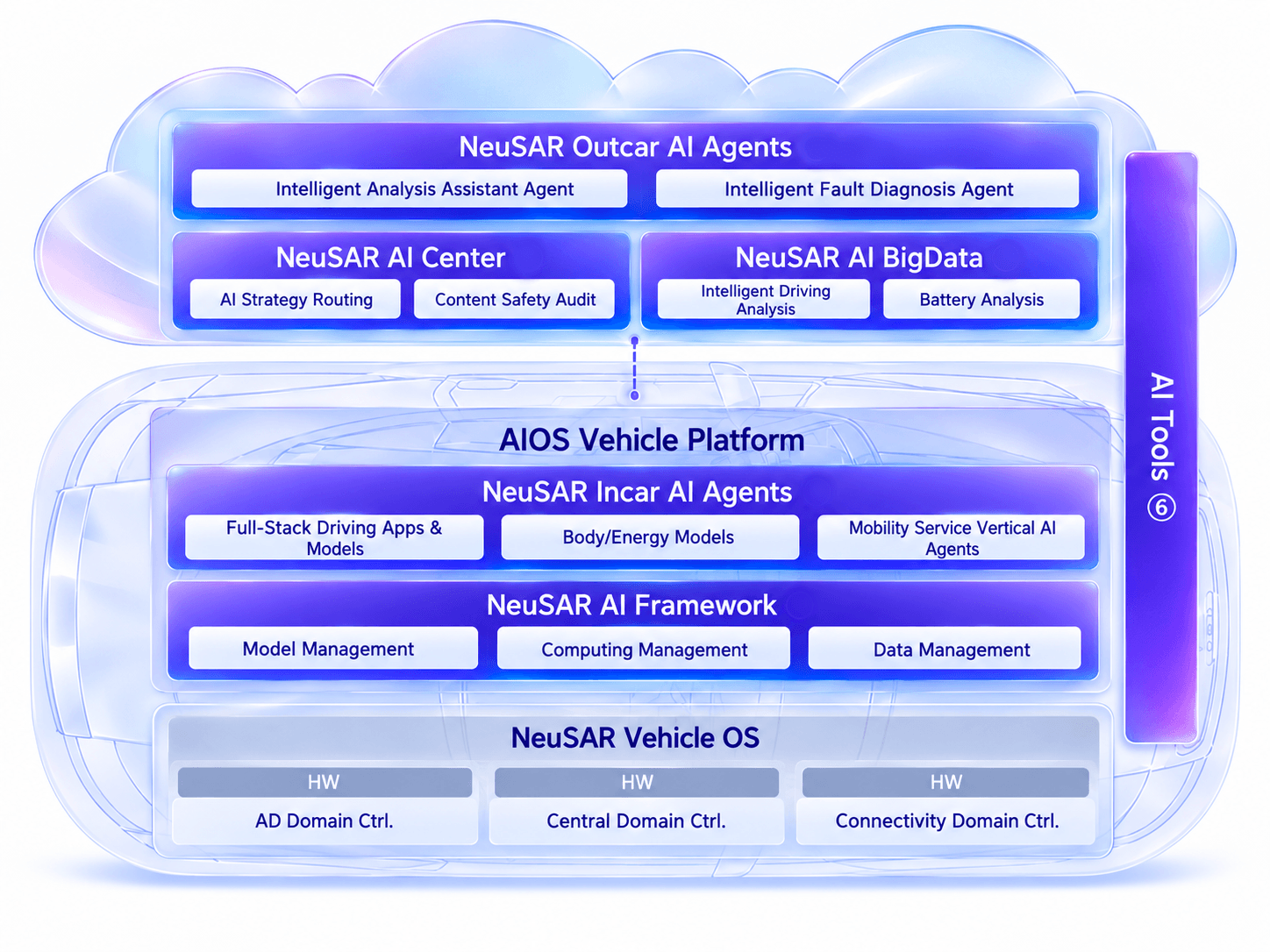
AIOS provides OEMs with an efficient, flexible software foundation for developing differentiated intelligent features. It supports a library of 300+ scenarios, extensive training data, and domain-specific expert models. Powered by the NeuSAR AI Framework for multi-agent development and orchestration, AIOS enables rapid in-vehicle deployment of AI agents and the flexible, reliable delivery of intelligent driving experiences.
Product Introduction
NeuSAR AI Framework
Multi-Agent Development and Orchestration
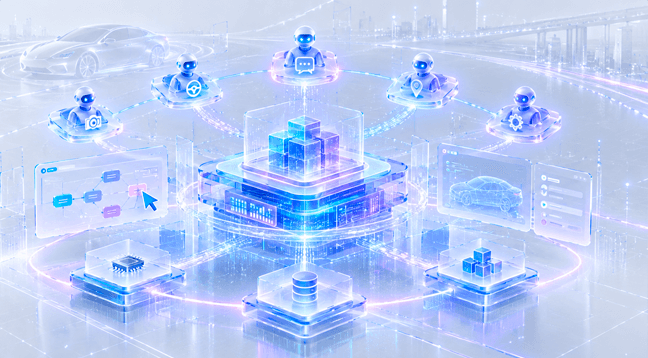
Designed for intelligent application development in the AIDV era, NeuSAR AI Framework provides comprehensive support for AI development, including multi-agent collaboration, model management, computing resource management, data management, and an end-to-end agent development toolchain. It unifies the management of shared resources—including computing power, data, and models—and enables graphical, drag-and-drop agent development. Based on user instructions, it dynamically selects and invokes the appropriate agents. This allows developers to efficiently build, deploy, and manage diverse AI agents with perception, decision-making, and collaboration capabilities.
NeuSAR Incar AI Agents
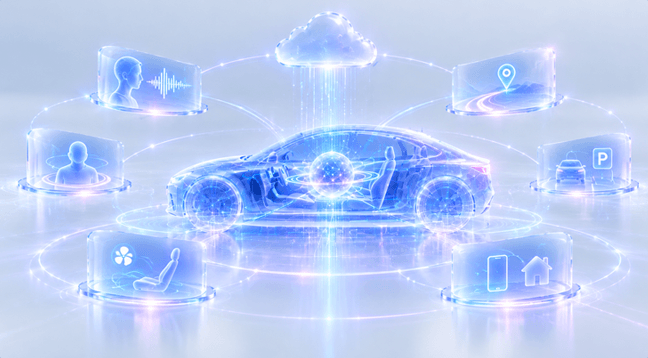
NeuSAR In-Car AI Agents is an intelligent agent solution for smart cockpits and vehicle control. Built on the NeuSAR AI Framework, it connects the cockpit, vehicle control systems, and cloud services to enable natural language interaction, user intent understanding, intelligent scenario generation, and cross-domain coordination. Integrating intelligent mobility assistance, vehicle usage assistance, driving recommendations, and long-term memory management, it supports diverse applications such as trip planning, smart parking, intelligent vehicle control, and cross-device task execution. By combining user preferences with real-time vehicle status, it evolves the in-car experience from reactive command execution to proactive, context-aware services. Its AI capabilities can be incrementally deployed on existing mass-production cockpit platforms, helping OEMs rapidly deliver differentiated, personalized, and continuously evolving smart cockpit experiences.
NeuSAR Outcar AI Agents
NeuSAR Out-Car AI Agents is a specialized agent solution for cloud-based vehicle data analytics and intelligent operations. Built on the NeuSAR AI Center and NeuSAR AI BigData platforms, it integrates vehicle operation data, intelligent driving data, and battery status data to power domain-specific agents for intelligent analytics and fault diagnosis. Combining large language model reasoning with domain-specific models, it transforms traditional data analysis workflows into intelligent, automated services. It helps OEMs improve vehicle quality analysis, troubleshooting, and product optimization, while providing data-driven support for intelligent driving algorithm iteration, battery performance management, and full-lifecycle vehicle services, turning large-scale vehicle data into sustainable intelligent service capabilities.

Core Product Capabilities
Multi-Agent Collaboration
Provides an in-vehicle multi-agent runtime environment for stable deployment and continuous iteration on vehicle computing platforms.
Atomic Capability Orchestration
Exposes vehicle functions—including communication, diagnostics, and OTA updates—as callable services, connecting agent reasoning with in-vehicle execution.
Multi-Model Integration
Supports unified integration of diverse foundation models and third-party agents, enabling model upgrades without restructuring upper-layer applications or underlying vehicle capabilities.
Safe Governance
Establishes manageable, auditable security boundaries for agent access to vehicle functions through permission management, command validation, sandbox isolation, and execution traceability.
Scenario Reusability
Provides a library of 100+ in-vehicle scenarios with centralized configuration, deployment, and management of scenarios and policies, reducing duplicated development across vehicle models.
 English
 简体中文
 日本語